
Molecules can be illustrated in a variety of ways which can make interpreting chemical diagrams confusing. Below is a brief lesson on how to read the most common types of chemical diagrams, including: skeletal structures, Lewis structures, and condensed formulas. The skeletal diagram is going to be the only type of diagram used in this website.
Molecules are “bunches” of atoms bonded together. The specific atoms within a molecule are indicated by the chemical symbol of that element as listed on the periodic table, so for example iron is represented by Fe and hydrogen is represented by H. Bonds between atoms can then be represented as lines connecting them. Fig 1 shows a water molecule, hydrogen atoms are represented by the H symbol and the oxygen atom is represented by the O symbol, it is clearly illustrated how they are connected using straight lines.
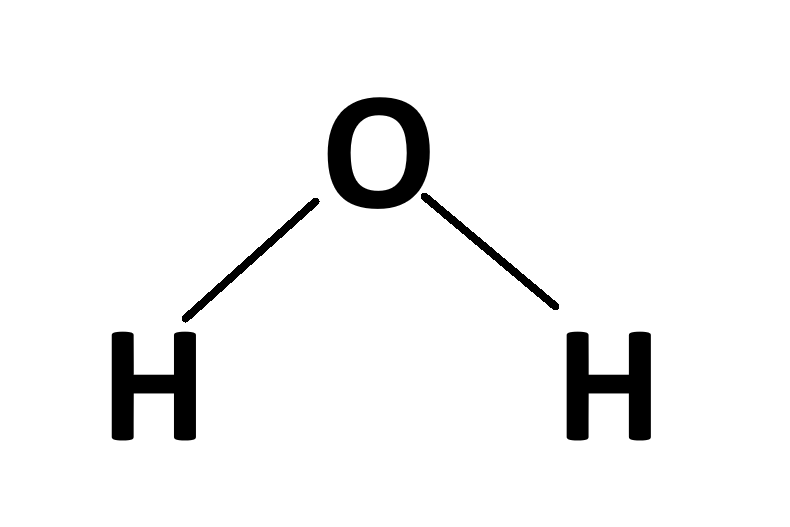
Fig 1: A diagram of water or H2O.
However in organic chemistry molecules can be incredibly large and take a long time to draw. To shorten the process, chemists created a faster way to write diagrams, this is called the skeletal structure, but can also be referred to as line structures, bond line structures, or line angle structures. The way that skeletal diagrams work is by shortening the most commonly found atom (carbon) into a blank space. Carbon atoms have the ability to form 4 bonds, so it is assumed in the diagram that if less than 4 bonds are shown to a carbon atom the remainder of the bonds are then bound to hydrogen atoms. Fig 2 shows an example of this shortening, the Lewis structure on the right has the elements fully written and annotated, whereas in the middle each end of a line is implied to be a carbon atom with the appropriate number of hydrogen atoms bonded to it.
Sometimes there may be double or triple bonds connecting atoms represented by two lines, this can be seen in the example second from the top in Fig 2. Sometimes the lack of bonds are shown by annotating the free electrons as dots, but these are unnecessary for the understanding covered in this website, nonetheless an example of this can be found in the bottom example shown in Fig 2.
The final column on the right side shows the condensed formula, using just the actual elements. In condensed form each new element is represented by a capital letter. Because some elements have 2 letters, the second letter will always be lowercase, such as iron (Fe) or magnesium (Mg). Numbers represent the amount of the element mentioned before it, the absence of a number then implies only a single atom. Sometimes numbers can precede elements, this number then refers to the amount of the entire compound after it, this is not in any examples within this paper although it is good to know if the reader wants to do further research.

Fig 2: A series of diagrams showing three different ways to show molecules with three examples.
A video explaining line diagrams can be found here: https://www.youtube.com/watch?v=RuKWQHwJldE
A video explaining chemical formulas can be found here: https://www.youtube.com/watch?v=EoaOaQGCfwE
More types of chemical diagrams not explained in this website can be found here: https://www.chem.ucalgary.ca/courses/351/Carey5th/Ch03/ch3-0-2.html