
This section assumes knowledge from the sections: DNA, Basic biology, Cancer.
The following section is on a treatment of cancer, it is not a guide on how to perform it, nor is it a guide as to the side effects or how to prepare for treatment. The following section is designed to give readers an in-depth understanding of the treatment, how it functions, and why it functions. Please note that researchers are constantly working to find new treatments or improve current ones, this means the subject(s) discussed below are likely to change as medicine improves.
Radiotherapy is a newer treatment that can be slightly unintuitive. As previously covered, radiation is a possible cause for cancer, so to clear up confusion this segment will cover a few current uses of radiotherapy in cancer treatment.
As covered in the section on causes of cancer, radiation with enough energy can be powerful enough to alter the chemical structure of molecules such as DNA. Additionally not all mutations cause cancer, cancer requires specific mutations in parts of the DNA that regulate cell replication. However cancer cells still need most of the DNA to be functioning so the cells can survive. By introducing controlled levels of radiation to tumors the radiation can destroy enough DNA that it leaves the cell unable to function, causing cell death. Cell death induced by radiotherapy can also sometimes attract immune cells as cancer cells may have unusual proteins within them (due to mutations), that can be released upon cell death.
(1)
Deciding how much radiation to give will be left to medical textbooks as it is highly nuanced and is decided on a case by case basis. However, a part that can be covered is how the radiation is actually delivered, below are the 2 current ways of delivering radiotherapy.
External beam radiotherapy (EBRT) is a common type of radiotherapy, usually using a linear accelerator also known as LINAC. LINAC machines spin around the patient delivering targeted beams of radiation. Medical staff use imaging parts of the machine to monitor the tumor’s position so as to limit damage to nearby healthy cells.
However mapping the tumor and shooting radiation at it from an outside source would still cause the most cellular damage to the tissue between the source of the radiation and the tumor, this is shown in Fig 1, the density of the color illustrates the intensity of the beam of radiation. This is why LINACs spin around the patient delivering less radiation on all points, and by targeting all of the beams at the tumor the tumor receives the most radiation as shown in Fig 2.
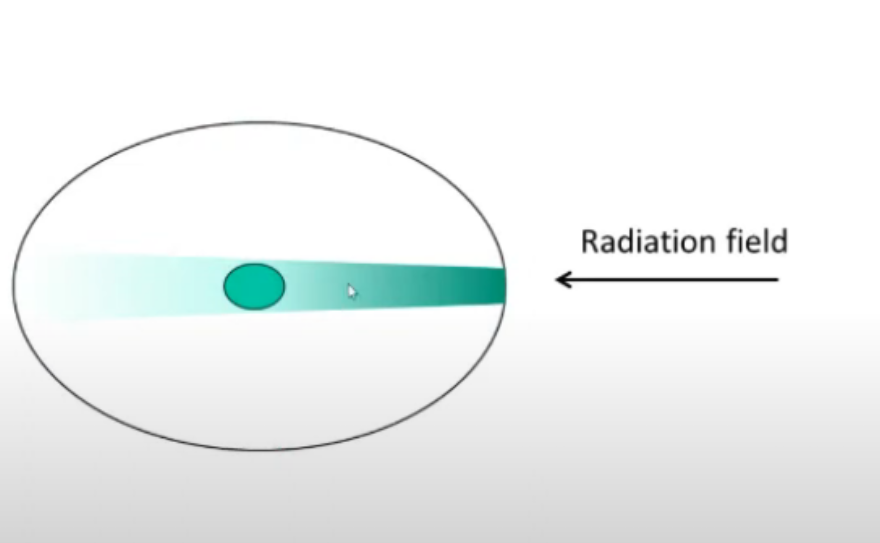
Fig 1: An illustration showing how radiation aimed directly at a target will deliver more radiation to matter in between the source and the target than to the target. Radiation is represented by green, the target is represented by the dot in the middle and the larger circle represents matter in between.
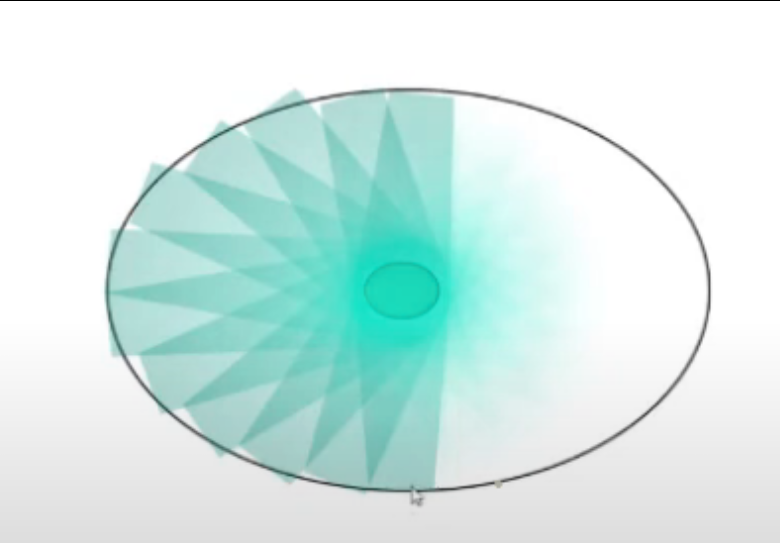
Fig 2: An illustration highlighting how aiming radiation from multiple angles at a single target causes more radiation to be delivered to the target than the surrounding matter.
Brachytherapy is a form of internal radiation therapy. This form of therapy implants small radioactive materials inside the body, usually in the form of pellets/beads or strings. Generally this is beneficial as higher doses of radiotherapy can be used than in external beam radiotherapy, as placing the source of radiation within the person can limit the damage to surrounding healthy tissue.
Brachytherapy can be broadly classified as either high or low dose radiotherapy. High dose brachytherapy is often only inserted into the patient for a few minutes before being removed. Low dose brachytherapy is left in the body for long periods of time usually decomposing within the body, or being surgically removed later. Usually these are small pellets about the size of a grain of rice.
(2)
| 1. | Alhmoud J, Al Moustafa AE, Malki M. Checking your browser – reCAPTCHA. Nih.gov. Published 2026. Accessed July 11, 2026. https://pmc.ncbi.nlm.nih.gov/articles/pmc7226105/#sec8-cancers-12-01050 |
| 2. | Mayo Clinic. Brachytherapy – Mayo Clinic. Mayoclinic.org. Published 2018. Accessed July 12, 2026. https://www.mayoclinic.org/tests-procedures/brachytherapy/about/pac-20385159 |