
Cells were briefly explored in the basic biology section, however it is important to understand some important aspects of cellular biology in order to properly understand how cancer functions.
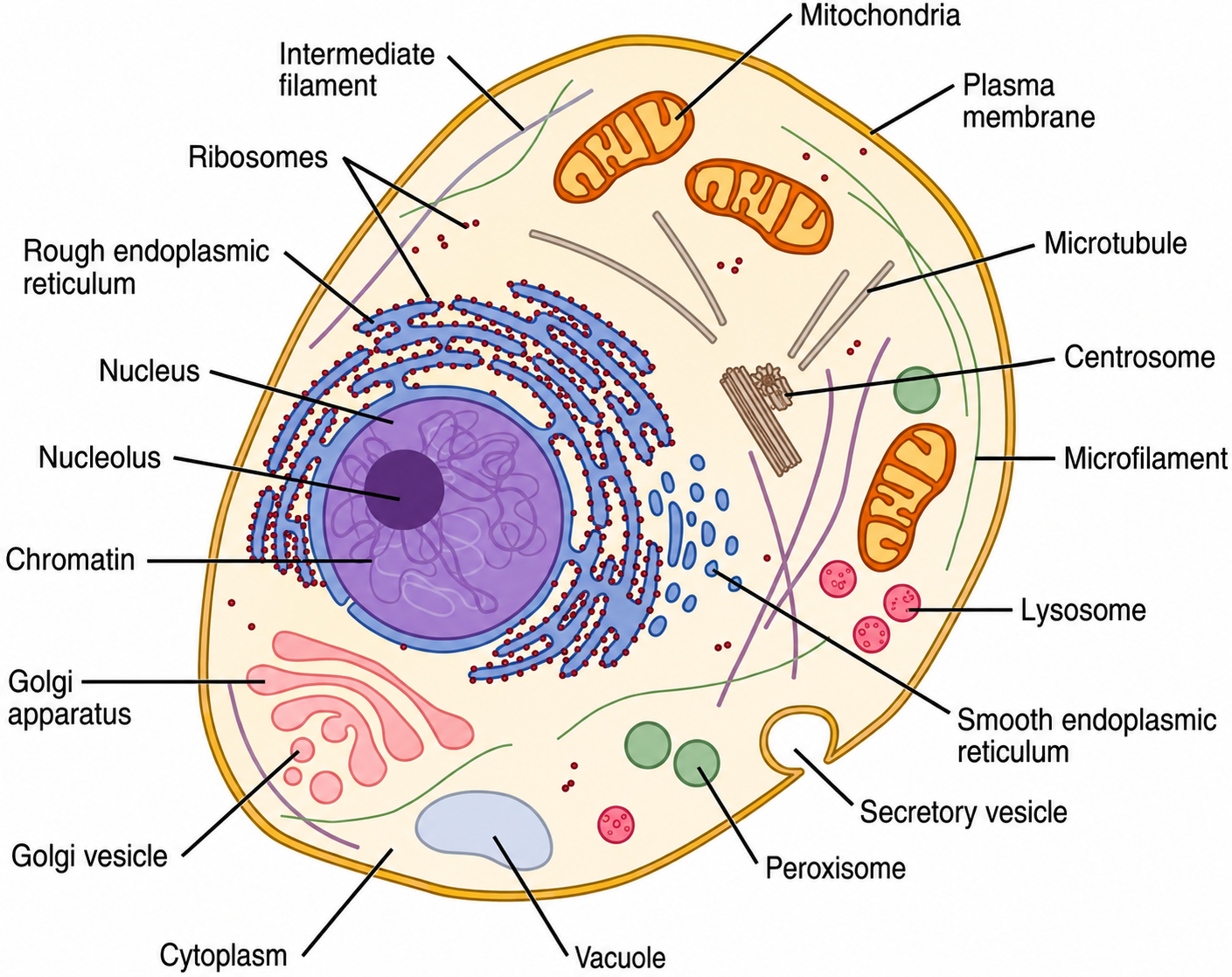
Fig.1 is a complex image that illustrates the organelles found in most human cells. This cell has no specialised structures and simply aims to show all of the essential parts of human cells. It is important to remember that cells can be vastly different depending on which tissue they have specialised into, and of course which species they belong to. For example, Fig.2 shows a specific class of neuron. Neurons are specialized cells made to be a part of the brain and transmit signals between each other. Although the neuron contains all the same organelles and parts as Fig.1, they are expressed in different amounts and sizes, even the overall structure is vastly different. There are around 30 trillion cells in the human body and these cells can be easily observed under a microscope.
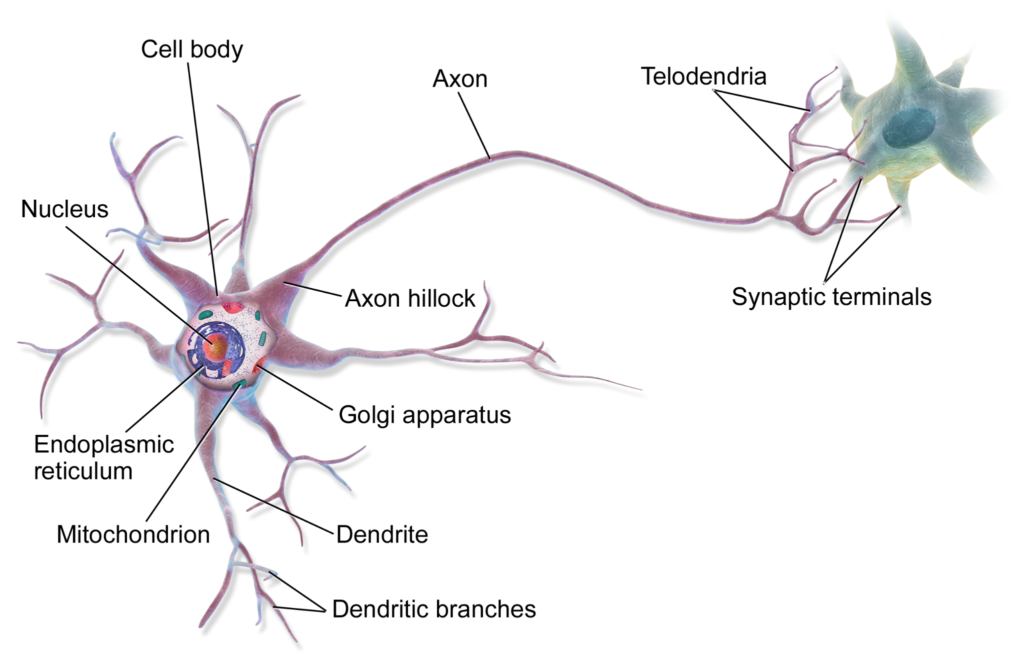
There are many more cells and more complex diagrams showing each of the minute details about all of the organelles. However this website will only be focusing on those parts relevant to understanding cancer.
One of the most important things to understand about cells are proteins. Proteins are chains of amino acids that have been folded into specialised shapes. Proteins perform almost all functions within the cell; conveying signals, moving substances, regulating cell health, almost anything a cell does can be linked back to the proteins it produces and uses. To go over all of the functions of proteins would take up the rest of this paper and likely all of the reader’s patience. More on protein synthesis here.
There are a few organelles in a human cell that should be focused on for understanding cancer, the first is the nucleus. The nucleus is an organelle that is made to envelop the DNA of the cell. The purpose of the nucleus is to organise and protect the DNA within. By having the DNA enclosed within a specific area, the DNA is protected from toxins and biological processes that may damage it. The nucleus, when viewed through a microscope, is often seen as a small dense circle towards the centre of the cell. Organisms can also be classified based on whether they have a nucleus or not, prokaryotes are defined as not having a nucleus with DNA floating freely in the cell, eukaryotes (such as humans) have a nucleus to contain DNA. More on DNA here.
Another key term to know in cellular biology is “intracellular fluid”, this is the fluid within all cells. The intracellular fluid is largely made of water and is sometimes referred to as “cytoplasm”, although the term cytoplasm also includes everything within the fluid (organelles proteins etc). Extracellular fluid is a term used to describe all liquid outside of cells, including plasma and the interstitial fluid.
Finally, it is important to mention the cell membrane. The membrane is a phospholipid bilayer, this means it is made of 2 layers of phospholipids. A phospholipid is a molecule with a hydrophilic head and hydrophobic tail, meaning the heads face towards the intracellular and interstitial fluid as these are mostly water, while the hydrophobic tails point inwards towards the fatty centre of the membrane. Fig 3 illustrates this model, however it lacks the proteins usually found on the surface. These proteins (called surface or membrane bound proteins) can have a variety of tasks, some are made to allow specific substances into the cell (such as protein channels), while others receive chemical signals and cause change within the cell (receptors).
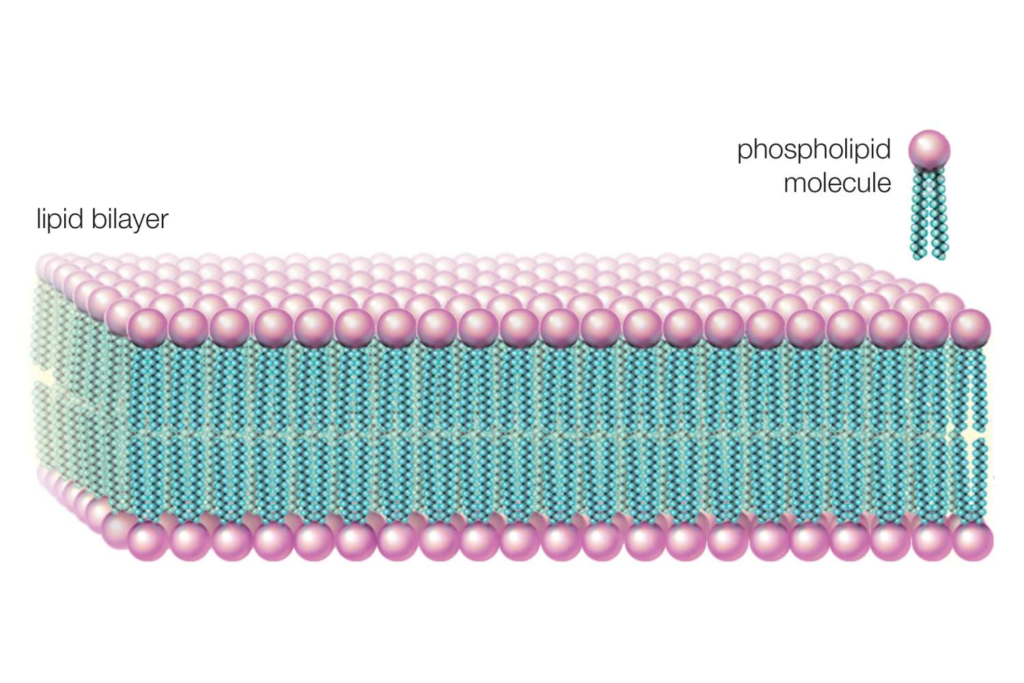
Fig 3: A simplified image of a small part of a human cell membrane.
:max_bytes(150000):strip_icc()/lipid_bilayer-5b96eddf46e0fb0025509dde.jpg)
More on the structure of human cells here: https://medlineplus.gov/genetics/understanding/basics/cell/