
This section will briefly cover the immune system. It will explain why cancer cells are often able to evade the immune system, and then go into more detail for those curious to more deeply understand immunotherapy.
The functioning of your immune system is based upon destroying things it recognises as foreign, called antigens. Proteins on the surface of normal cells and non-harmful substances should go undetected by the immune system. This is why cancer does not have the usual symptoms of being sick as these cancer cells usually still have the normal surface proteins, and all of the usual sickness symptoms are caused by the immune system.
A more in depth look at the immune system can be found below.
The immune system is usually explained in 3 phases although some institutions or people could break it up differently. Generally the first line of defense is the physical barriers that protect the body, the second activates once antigens are inside the body, and the third is a group of cells that target specific antigens.
Note: some may describe the first 2 lines of defence as the innate immune system as they work universally and are not specific to any specific antigen, while describing the third line of defence as the adaptive immune system as it does target specific antigens. These categories are once again up in the air as they do not actually mean anything beyond being an “easier” way of explaining the immune system.
The first stage or level of the immune system are the regular barriers of the human body. This includes features such as the skin, which forms a physical barrier to keep out unwanted pathogens or substances. Other features such as the acidity of saliva or the digestive system can dissolve foreign bodies. There is also a variety of bacteria and oils on our skin that are harmless and work to make the skin less inhabitable for other microbes. The last part usually mentioned are the mucous membranes that line most human orifices, mucous often traps unwanted pathogens or substances.
The next level or stage of the immune system is mostly separated from the other 2 simply by not being the same as either, it is not a physical barrier, and it does not target specific antigens. This stage includes cells such as phagocytes which are a class of immune cells usually found within the circulatory or lymphatic system. Phagocytes function by ‘bumping’ into various substances, and when they encounter an antigen they can begin a process known as phagocytosis. Phagocytosis is the process of one of these cells enveloping and destroying a particle or microbe. Most of these phagocytes will then present parts of what it has digested on its surface which can help activate the next and most complicated part of the immune system.
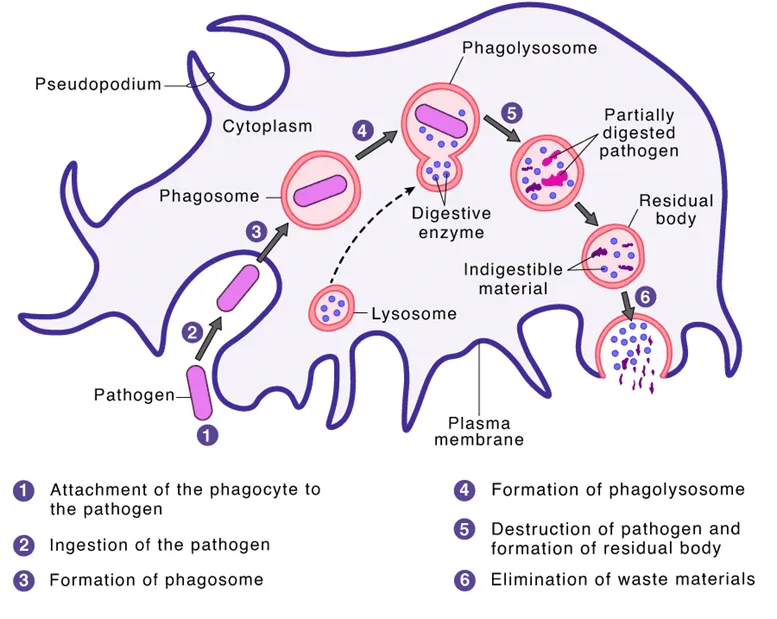
Note: there are a variety of different phagocytes within the human body. Cells such as dendritic cells, macrophages, neutrophils and monocytes are all types of phagocytes that function very similarly.
The second level of the immune system also includes things such as inflammation, when the body detects an antigen many different cells can release pro-inflammatory cytokines. That simply means cytokines that promote inflammation. Inflammation in a biological context actually refers to something known as vasodilation. Vasodilation is important for 2 main reasons. First, pro-inflammatory cytokines are only released in areas where an antigen has been found, this means blood flow slows and blood cells (such as phagocytes and other immune cells mentioned below) accumulate in this area. Second, by swelling the veins: the layer keeping the blood from the tissue gets thinner, this allows blood cells to more easily diffuse through the vein walls into the surrounding tissue.
The final part of this level of the immune response are fevers. Fevers are a whole body response to antigens, the aim is to increase the temperature of the human body, hopefully killing pathogenic microbes within it.
The last and most complicated level of the immune system is the adaptive immune system. The main 2 parts of this are T cells and B cells, both of which come in a variety of different types. Firstly T cells are white blood cells that start off as naive or unspecialised T cells. Naive T cells stay in this form until they encounter an antigen, this is usually via antigen presentation. Antigen presentation is a process phagocytes perform where they present antigens on their surface that T cells can interact with and become activated off of. For context, the molecule used to present the antigen is an MHC (major histocompatibility) class II molecule, these proteins are only found on the surface of phagocytes designed to present antigen, these cells are sometimes known as APCs (antigen presenting cells). After being activated T cells can specialise into 1 of 3 types:
- Cytotoxic T cells, or the less formal name, killer T cells. Cytotoxic T cells bind with regular cells and check the MHC class I molecules that are present on all cells in the human body, if the antigen that activated it is present it can induce apoptosis.
- Memory T cells although these memory cells are less talked about in literature they do exist, memory T cells simply stay inside the human body for an extended period beyond the duration of the infection. By staying in the body longer, memory T cells are more likely to find pathogens early in the infection and promote an immune response or kill the infected cells themselves.
- The final type of T cells are known as Helper T cells, once activated these T cells then help activate the next type of white blood cell, B cells.
B cells are an incredibly important part of the immune system as they produce proteins known as antibodies. Antibodies are proteins made to bind to specific foreign proteins, by binding to pathogens it can signal its destruction from other parts of the immune system (usually phagocytes) or simply block its ability to bind to other cells. Naive B cells are only able to produce antibodies bound to its surface, however when naive B cells encounter a pathogen its specific antibody is able to bind to, it becomes activated. Activated B cells can specialise into plasma burst cells, which produce free antibodies that circulate in the bloodstream, however these cells are short lived. To specialise into more effective longer lived cells, B cells must be activated by helper T cells. When a helper T cell encounters an activated B cell it can confirm with the B cell causing it to specialise further into either plasma or memory B cells. Plasma B cells are very functionally similar to plasma burst B cells however these produce more antibodies and live longer. Memory B cells are B cells that keep the antibody that was effective, and remain in the body for upwards of 80 years, these cells ensure that upon re-exposure to the antigen the body will be able to recognise the antigen quicker, and respond with far more antibodies than before.
Note: Vaccines aim to stimulate memory B-cell production with less risk than actual exposure to the pathogen.
More on the immune system here:https://my.clevelandclinic.org/health/body/21196-immune-system